At its foundation, slavery in America was a debated topic, and the morality of which divided the leaders of the country for almost a hundred years. During my research for Patriots and Providence (my latest book), I stumbled across this quote by John Adams:
“Every measure of prudence, therefore, ought to be assumed for the eventual total extirpation of slavery from the United States.”[1]
Though it’s not a topic I cover in my book, my curiosity grew, and with Juneteenth arriving, I thought I would do a blog post discussing a general overview of slavery in America. Just like my book, I view this with the perspective of a Christian, but it’s important when we look this far back to do so within the context of the time.
1- The Founding Fathers
Our Founding Fathers grew up in a society of colonies where slavery was not only legal, but a sign of wealth and a means to achieve it. Despite this, several Founding Fathers were outspoken against slavery.
John Adams, probably the most notable of them all, famously never owned slaves and remained against the practice for his entire life. Other figures, such as Ben Franklin and George Washington did own slaves, but learned the error of their ways and eventually freed them[2]. Ben Franklin dedicated much of his time in his later life to fight to abolish slavery within the U.S. and his final official act before he passed away was presenting a petition regarding this.[3]
In 1774, Alexander Hamilton presented to Congress that “All men have one common original: they participate in one common nature, and consequently have one common right.”[4]
Lesser-known, though still influential people in the sphere of the Revolution, are those of John Laurens and the Marquis de Lafayette, who also opposed enslaving other people.
2- Jefferson to Lincoln
To my surprise, when researching for this post, I found that many leaders felt conflicted with the idea of slavery and their view of the American Revolution. They were conflicted with the concept of personal liberty for all, and their own wealth, especially in the South. Plenty of leaders opposed slavery, but prioritized preserving the union over all things when making decisions. At the time of the Civil War, the American Revolution was as recent to them as WWII is for us today. Because the major exports from the south acted as the backbone of the American economy, the plantations had major sway in legislation for decades.
Many perceive the people of this era without nuance, and in such throw overly broad statements of racism that skew the perception of the era as a whole. I want to advocate for viewing history and humanizing the figures we learn about, not to say that what they did was okay, but in the way that humans make mistakes. Some, like Franklin and Washington, learn from their errors and work to make it right. Others may fall to the pressure of the world around them. In this section I will name a few leaders that stand out as exemplary for their time, regarding abolishing slavery.

President John Quincy Adams (son of John Adams), a fiery and loud opponent of slavery, was vital in the abandonment of the “gag rule,” which was a way for pro-slavery leaders to nullify anti-slavery legislation. Doing away with this is a radically important stepping stone towards freedom for those enslaved in America.[5]

William Lloyd Garrison published a weekly paper called The Liberator for over 30 years with his outspoken views against slavery, ending in the year that the Civil War concluded.[6]

Frederick Douglass, an invaluable member of the anti-slavery movement, was an author and activist who eventually advised Abraham Lincoln during the Civil War.[7]

Harriet Tubman, a figure so great, needs no introduction or summary, but this quote nearly brought me to tears as I compiled resources for this post and I had to include it:
“God’s time [Emancipation] is always near. He set the North Star in the heavens; He gave me the strength in my limbs; He meant I should be free.”[8]
3- Lincoln to Juneteenth
With both grueling war and politics, Lincoln navigated the country through the Civil War and the fight for civil rights. I love this quote of his that discusses the innate understanding of the wrongness of slavery.
“[evi-]dent truth. Made so plain by our good Father in Heaven, that all feel and understand it, even down to brutes and creeping insects.”[9]
I won’t get into every detail of the Civil War here in this post, that seems like a book in and of itself (and who knows, maybe I’ll write one on God’s role in the Civil War someday).
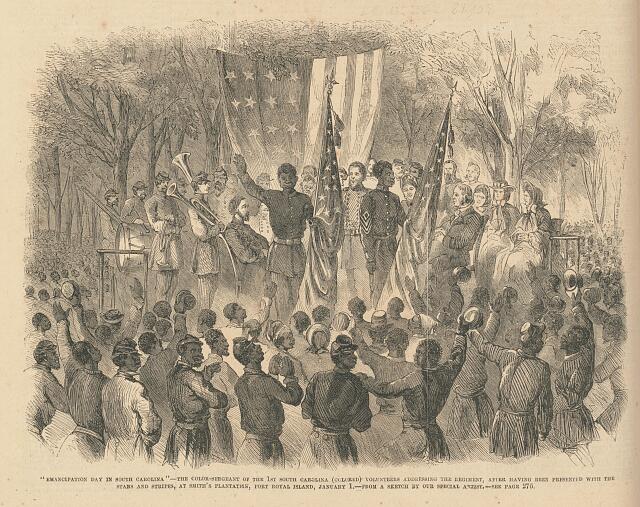
Juneteenth marks the official end of slavery in the United States, as the last of the slaves were freed in Texas on June 19, 1865. It took a couple of years for the emancipation to reach all enslaved people and free them from their chains, but with June 19, the phrasing of the Declaration was well on its way to coming true for every man: “All men are created equal.”
As we celebrate the events of Juneteenth, and the freedom that it brought for slaves in America, I think about this quote from John Quincy Adams:
“Roll, years of promise, rapidly roll round,
Till not a slave shall on this earth be found.”[10]
Slavery has not yet been fully abolished on this earth, and while our progress is something beautiful to be celebrated today, there is still more work to be done for those still in bondage today. I felt convicted to share this thought as I was writing this.
“It is for freedom that Christ has set us free. Stand firm, then, and do not let yourselves be burdened again by a yoke of slavery.” (Galatians 5:1, NIV)
To learn about modern slavery, and how you can help, read this.
Have an incredible Juneteenth!
Written by Preston Smith, June 19, 2026
Sources
All photos courtesy of the Library of Congress.
- John Adams, “Letter to Evans, June 8, 1819,” in Founding Fathers Library, Founding.com, accessed June 19, 2026, https://founding.com/founders-library/american-political-figures/john-adams/letter-to-evans/
- “Washington’s 1799 Will,” George Washington’s Mount Vernon, accessed June 19, 2026, https://www.mountvernon.org/george-washington/slavery/washingtons-1799-will
- “Benjamin Franklin’s Anti-Slavery Petitions to Congress,” National Archives, last reviewed August 12, 2019, https://www.archives.gov/legislative/features/franklin
- Alexander Hamilton, A Full Vindication of the Measures of the Congress, &c., [15 December 1774], in The Papers of Alexander Hamilton, vol. 1, 1768–1778, ed. Harold C. Syrett (New York: Columbia University Press, 1961), accessed June 19, 2026, https://founders.archives.gov/documents/Hamilton/01-01-02-0054
- “John Quincy Adams,” White House Historical Association, accessed June 19, 2026, https://www.whitehousehistory.org/bios/john-quincy-adams
- The Editors of Encyclopaedia Britannica, “William Lloyd Garrison,” Encyclopaedia Britannica, accessed June 19, 2026, https://www.britannica.com/biography/William-Lloyd-Garrison
- The Editors of Encyclopaedia Britannica, “Frederick Douglass,” Encyclopaedia Britannica, accessed June 19, 2026, https://www.britannica.com/biography/Frederick-Douglass
- Angela Tate and Romya-Jenevieve Jerry, “Harriet Tubman: Life, Liberty and Legacy,” National Museum of African American History and Culture, March 4, 2022, https://nmaahc.si.edu/explore/stories/harriet-tubman
- Abraham Lincoln, “Speech on Slavery and the American Dream (1858),” Gilder Lehrman Institute of American History, accessed June 19, 2026, https://www.gilderlehrman.org/history-resources/spotlight-primary-source/lincoln-speech-slavery-and-american-dream-1858
- National Christian Foundation, “John Quincy Adams on Freedom and Justice,” NCF Giving, July 3, 2019, accessed June 19, 2026, https://www.ncfgiving.com/stories/john-quincy-adams-on-freedom-and-justice/
Interesting Reads
The Founding Father’s View of Slavery by Mark Maloy
https://www.battlefields.org/learn/articles/founding-fathers-views-slavery
The Founding Fathers and Slavery by Anthony Iaccarino
https://www.britannica.com/topic/The-Founding-Fathers-and-Slavery-1269536
Benjamin Franklin and Slavery from The Franklin House (Very in-depth look at his life in relation to slavery)
https://benjaminfranklinhouse.org/education/benjamin-franklin-and-slavery/
John Laurens Biography by Lane Gooding
https://www.thenmusa.org/biographies/john-laurens
Historical Abolitionist of the Month: John Quincy Adams by Emily Balan
https://www.humanrightsfirst.org/library/historical-abolitionist-of-the-month-john-quincy-adams
How Abraham Lincoln Broke the Barrier Between Church and State by Joshua Zeitz